









 | |||||||||||||||||||||||||||||
Tibet, the highland of central Asia and Himalayas are known for the origin of the lacquer tree. As broadleaf tree, the height the lacquer tree is 20m and its diameter is 90cm. The lacquer tree has been cultivated in China 4,000 years ago. In South Korea, the 2000-year old lacquer wares were founded in the Nakrang ancient tomb and the excavation site at Sinchang-dong in Gwangju-si. Those lacquer shows that woodenwares with lacquer finish had used from the prehistory age in all the area of South Korea.
In the orient, the lacquer has been collected from the various lacquer tree thousands years ago. The lacquer has been gathered from the lacquer tree (Rhus verniciflua Stokes) In China, Japan, and Korea, the wax tree (Rhus succedanea) in Vietnam and Taiwan, and the Burmese lacquer tree in Myanmar. The lacquer tree had transmitted from China to Korea, Korea to Japan. The major component of the lacquer tree is urushiol.
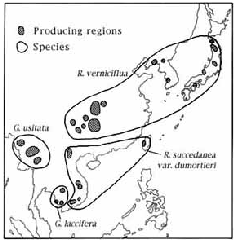
[Distribution Chart of Lacquer Tree and Lacquer Producing Region]
There are three traditional methods to collect the lacquer. First, there is the cutting method. The bark of the lacquer tree is cut and the lacquer is coming out from the cut area. By this method, the lacquer is collected from June to September. After the collecting period the lacquer tree is cut and is naturally regenerated from its shoot. And then the collecting method above is repeated during the collecting period. Second, there is the curing method. It is same as the cutting method to cut and collect the lacquer. But the lacquer tree is collected during the short period time and left for one year or two years. After the one-year or two-years, the collecting process is repeated for three times and the lacquer tree is cut. Third, there is the fire method. The round-shaped grooves are made on the cut lacquer tree in 10cm of distance between the grooves. And the groove is heated and the lacquer comes out through the groove.
The color of the fresh collected lacquer is white and contains 70% of urushiol, 4~8% of rubber, 2~3% of glycoprotein, enzyme (laccase) and 10∼20% of water.
The lacquer collected by the fire method is the ashy colored oily liquid and contains 55% of urushi, 4~8% of rubber, 2∼3% of glycoprotein, enzyme (laccase), 10∼40% of water, and 1~2% of flavonoids(1∼2%).
The fresh lacquer has chemically different components that are separated in the tissue of the bark. When the groove is cut, the components, which contain plenty of urushiol, water and polysaccharide, are mixed as emulsion status. But the status is not even. The components have plenty of laccase that makes the lacquer easily hardened even though in high humidity. This formation of the components effects the prompt polymerization of the lacquered woodenware. From the rapid polymerization, the wrinkles, the defects of lacquered finish, on the lacquered woodenware are easily occurred. The discoloration of the lacquered finish is happened by plenty of polysaccharide and the deterioration of the lacquered film is occurred by the infrared ray.
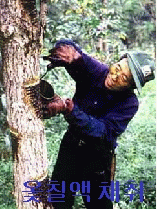
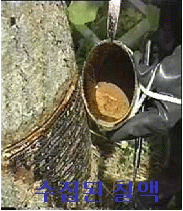
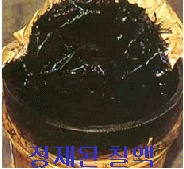
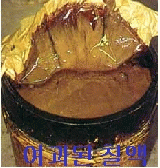
[Collection and Refining of Lacquer]
Being a traditional paint, the lacquer has the strong durability that the 3000-year old lacquer film is maintained until now. The lacquer is still used for many products that require the strong durability (floor panel of Mercedes Benz). The lacquered film has the powerful chemical resistance that the film is not corroded in various organic solvents at all. As the industrial paint that requires the strong durability, the lacquer could be developed and used for oil tanks, oil pipes, LNG tanks, and pipe-laying facilities of chemical factories.
[Hardening of lacquer]
[Collection of Lacquer] [Collected Lacquer]
[Filtered Lacquer] [Refined Lacquer]
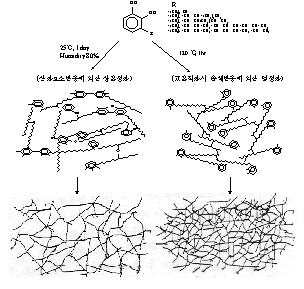
[Formation of Lacquered Film]
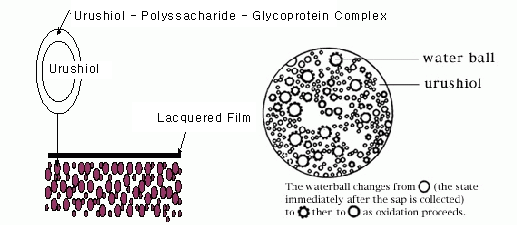
[Anticancer Effect of Urushiol]
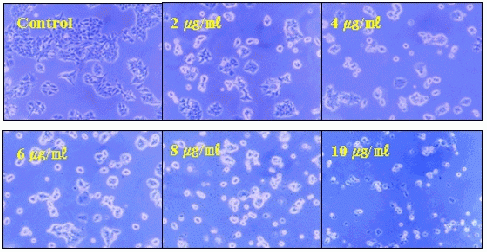
The lacquer shows the excellent anticancer effect from the comparison between tetraplatin, the drug on the market, and the urushiol, the major component of the lacquer. The urushiol has the anticancer effect 3.4 times better than the tetraplatin on L1210, 3.9 times better on PC-9, and 105.5 times better on A427. On Kato III, the effect is reduced 3.9 times. The anticancer effect of the urushiol is 10 times better than carboplatin or cispaltin of the platinum anticancer drugs, which are widely used as the anticancer medicine. The urushiol has the excellent control effect of the proliferation of cancer cell than the tetraplatin whose side effect has been reduced. These anticancer effect of the urushiol shows the possibility that urushiol could be used as an anticancer medicine.
[Anticancer Effect of Urushiol on MCF-7 Cell]
[Medicinal Effect of Flavonoids]
:: Anticancer effect (Control effect of blood vessel formation)
From the tests on rats, the gastritis control effect of flavonoids shows 43.5% on the 100㎎/㎏ of injection, 68.5% on 300㎎/㎏ of injection, and 78.8% on 1000㎎/㎏ of injection. The median effective dose (ED50 (mg/kg)) is 121mg/kg.
:: Hangover Solution Effect
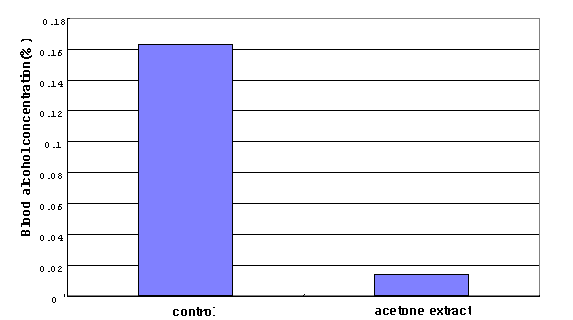
When 2㎖of the flavonoids in the concentration of 500㎎/㎖ is injected to a rat, the blood alcohol level of the 40% alcohol-injected rat is reduced from 0.162% to 0.014%.
:: Liver Protection Effect
40% Alcohol Treated 40% alcohol + flavonoids
:: Gastritis Protection Effect
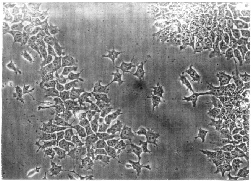
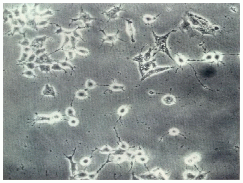
When the flavonoids are injected into F9 deformed cancer cell, the unique gene for the organ differentiation of cancer cell is transformed and the differentiation of the round-shaped normal organ cell is confirmed.
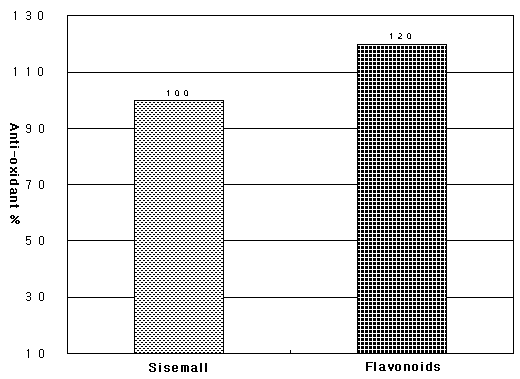
:: Anti-oxidant Effect
[Cancer Cell] [Treatment of Flavonoids]
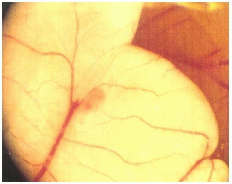
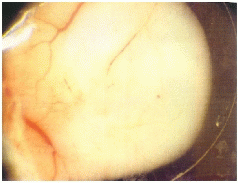
The flavonoids show the excellent control effect of blood vessel formation by the chick embryo chorioallantoic membrane (CAM). The control effect of the flavonoids shows 31% on 10㎍ of crude extract, 45% on 50㎍, and 79% on 100㎍. The effects of the treatment on 10㎍ of each refined compound are 42% on compound 1, 30% on fustin, 57% on fisetin, 43% on sulfuretin, and 57% on butein.
[Organ Differentiation Inducement]
Untreated [Treatment of Flavonoids]
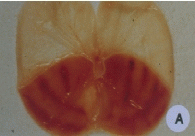
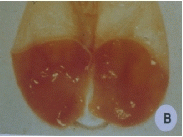
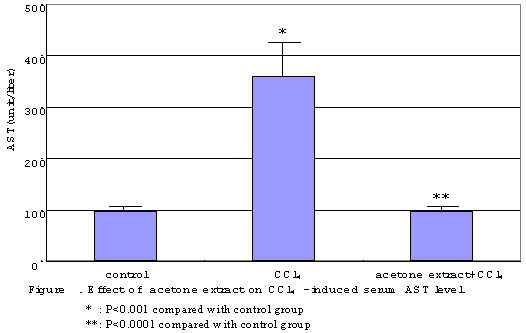
The carbon tetrachloride (CC14), the toxic material of liver, increases the level of AST. To examine the liver protection effect of the lacquer tree extract for the liver toxicity, the extract is injected to a rat that is treated once with CC14 and AST drops to the level of control group. This examination shows that the extract of lacquer tree has the liver protection effect.
[Characteristic of the Toxicity of Lacquer Tree]
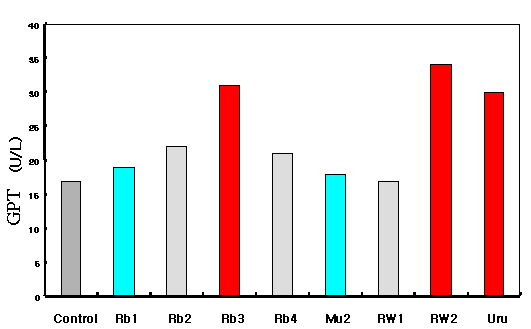
When the extract fraction of the bark (Rb3), fruit juice extract (RW2), and urushiol (Uru) from the lacquer tree is injected for one month, GPT, the level of liver toxicity, is radically increased. This shows that the extract of the lacquer tree is not good for health without the information or knowledge about the extract. But the fractions of MU2 and RB1 don’t show any liver toxicity after the long period of taking the extract.
