










 | |||||||||||||||||||||||||||||
Cultivation and Management of Japanese Raisin Tree
1. Intensive Cultivation for the production of 1-year old branch
A. Background
Even though the fruit of Japanese Raisin Tree has excellent efficacies, it is hard to be used industrially due to the irregularity of fruition, natural picking, unpredictable harvesting amount, and expensive picking cost.
The one-year-old branch has 1.1% of the active material that is also found in the fruit (fruit stalk). And its medicinal effects are excellent for hepatitis, fatty liver and liver toxicity. But currently, the branch could not be used for food because of its toxicity. Tree of Life Co., Ltd. is working on the solution through our continuous study.
B. Goal
Achievement of System for Predictable Material Supply through the production of the one-year-old branch of Japanese Raisin Tree.
C. Growing Feature of Japanese Raisin Tree
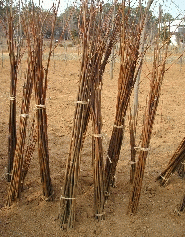
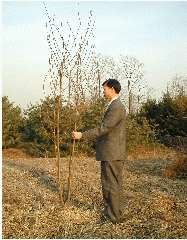
[The one-year-old plant with seed breeding]
[Chart 1. Growth of
Japanese Raisin Tree in
Age]
|
|
Root
diameter |
Height of
Plant |
Production/ |
Note |
|
1-0
Plant |
0.4∼0.6 |
50∼100 |
|
|
|
1-1
Plant |
0.8∼1.5 |
100∼170 |
≒250g/plant |
|
|
1-2
Plant |
1.8∼2.2 |
150∼210 |
≒850g/plant |
Growth of 3~5 branches from original branch when the 1-1 plant is borrowed. |
1-0: One-year-old plant
without transplant of plant that is bred by
seed.
1-1:
Two-year-old plant after one year from the transplant of
the 1-year plant that is bred by
seed.
1-1-1:
Three-year-old plant that 1-year old plant is double
transplanted.
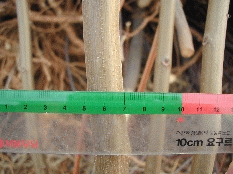
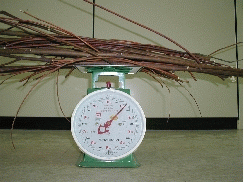
The new One-year-old branch grows up to 2m of height with
2cm of thickness and produces 1.2kg of
untreated weight (dry weight 850g) per
year.
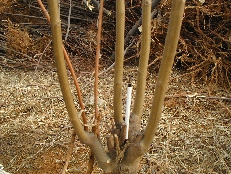
[The growth of disbranched 1~2 plants for one year]
[Thickness growth of the young branch]
A. Selection of the cultivating location
- The
most important thing for the cultivating location of
Japanese raisin tree is the place with good drainage.
- Closed
grazing land, field, or cultivated land with plenty of
organic
substance.
- Hummock
adjacent cultivated land that the farm mechanization is
impossible and the farm machine is hard to approach.
- If
the Japanese raisin tree is used for the purpose of
forestation, the cultivating location is not hard to
select. The fundamental condition of cultivating
location for the Japanese raisin tree is the place with
excellent drainage and plenty organic substance and
without severe dryness and wind.
- Avoid the
place that is repeatedly flooded in rainy season.
- The drain
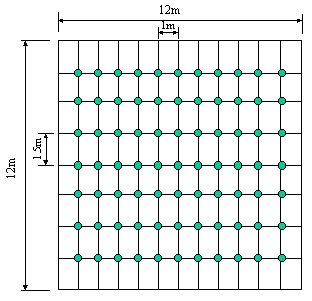
road should be made as 1.5 x 5m of the space between the
drain roads and 30cm of depth, if the cultivated location
is the place that the field is originally a paddy field or
that the drainage is not excellent.
B. Planting Method
- The
Japanese raisin tree could be planted with tillage and
rotary in the closed grazing land with plenty of organic
substance. When the location does not have enough
organic substances and is hard for dry-field farming, the
excrement compost of cow or organic compost could be used.
- For
the planting of the Japanese raisin tree, dig the soil up
to 10 cm of depth and check the moisture by grabbing the
soil. If you could feel the moisture on your
hand, plant the tree right on the spot. If not,
make the puddle soil. Then deep the root of the
Japanese raisin tree in water and plant it in the soil.
- If
the drought is continued after the planting in the dry
soil, water the plant to improve the migration rate of the
plants.
- The
planting method is the same as that of general plants.
C. Damage by blight and insects and insect control
[Young branches from the cut trunk] [Thickness growth of the young branch]
